Tuesday, November 16, 2010

2010.11.16 — Not Far from the Madding Pole — a fushigi

I got to work several hours late this morning. It was a surprisingly beautiful — cool, almost cold — day with clean air and brilliant colour on the trees and in the sky making it a perfect day to be getting to work late. I was late because I had taken my wife and I to a medical lab for blood works. That was extended because, after that, I waited in the car reading Made in America by Bill Bryson while my wife visited her medical specialist.

But, once at work, the perverse fushigi gods got together to mess with me. This very weird work one began in the year 2004. As such, unfortunately, a bit of boring background is needed in order for the fushigi to mean anything. The following events, while real, have been paraphrased and shortened to minimize the reader's pain.

Back in CW, a very green tech, was directed by our mutual and also relatively green, design manager, to fix a 'discovered-while-doing-something-else' — not reported — aerial utility trespass. Once the design manager was out of earshot, I looked at the job as her trainer/mentor and recommended that she not do the work. 'This is an extremely difficult trespass to fix,' I said. 'And given that the utility trespass is in an industrial area and that no one is complaining about it, I recommend that you don't fix it at this time. Wait until there is an actual complaint.'

CW, wanting to accommodate her directive, consulted another tech who, unfortunately for her, concurred with my recommendation.

'But,' CW argued, 'my manager has told me that I have to fix it.'

'Okay. Just put it into the 'work-to-done-when-I've-got-nothing-else-to-do pile. Since you will always have work to do that is more pressing, you will be able to not do the work without saying you won't do the work.'

CW refused to do that because it was a bit too underhanded for her comfort.

So, abiding her manager's directive she proceeded to begin the design by first creating the work order.

She struggled to get the job designed, as well as co-ordinating the different companies required to fix the non-problem problem. I helped her for a while, and then, as time passed, I forgot about it. Eventually the entire department was re-organized and we reported to different managers. More time passed during which there was another re-organization, a lockout, and a return to work in 2006. Once again we reported to the same manager, although not the one we did in 2004.

In 2006 CW had been put on a special assignment before the now old trespass job rose up from the nearly dead jobs with a phone call I got from the city engineers. GB asked me when the work on this job would be completed. He was concerned because the 'new' pole hole that had been dug by the other utility company in 2004 was still a hole and the pole that was supposed to be in it was laying on the ground. Both constituted a public safety hazard.

When I looked at the job, parts of it had been done, but parts needed redesigning before it would be ready to recommence.
(The reason the pole wasn't in the hole was because doing that without the construction crews present would 'trap' the cables on the wrong side of the pole.) I finished the changes, (see clip from construction drawing showing date), and then arranged for the various parties to co-ordinate their efforts and gave it to logistics to book the various groups needed to get the work completed.

Since then I have received about two calls per year from either the city or my logistics people about getting the work completed. Each time I received a call arranged with the various parties and their crew chiefs to get themselves together on the job site. When in 2009 I received yet another call that the work was still outstanding I threw up my hands, blew a gasket, and gave responsibility for its completion to the design manager for the area. He agreed to take it on and subsequently I was notified by him that the work had been done shortly before he retired. Oddly enough, I learned on February 2nd, 2010 (I checked my work notes) that once again, I was told that the work was not completed. (I passed off the work to the retired manages tech to deal with and, more less, forgot about it.)

Now for the fushigi. This morning, CW, OS and myself were talking about challenging pole designs. The discussion got started because OS was in the middle of a somewhat difficult one, made more difficult by the city's odd demands about the guying. So, of course, CW's now notorious challenge became a topic of discussion. 'Is that job completed yet?' CW asked me. 'Perhaps," I said, 'but I doubt. I seem to remember taking a call about it this spring.'

After a bit more discussion about how his job haunts me, it was time to get back to work. We all turned to our computers. When I looked at my e.mail I could not believe my eyes.
By its time stamp, there had been dropped into my e.mail in-box during our discussion a notification that this job had been once again re-approved (financially) to proceed. I was incredulous, and so called CW and OS to show them how weird life is.

So, just coincidence? Or a synchronicity-petite?

Thursday, November 11, 2010

2010.11.11 — From 'Seven Rings' — A Poem

I was blog-surfing the other day, and came across the delightful a handful of stones, a blog 'celebrating the extraordinary in the ordinary.'

From the blog:


about a handful of stones
a small stone is a polished moment of paying proper attention. A shiny new stone will be published here every day.

The metaphor is to poetry: a stone is short poem, or poem-like observation of life. It is an expression of the practice of being absolutely alive, in this moment of being alive life. The selection of poems is exceptionally fine, and I recommend this blog highly.


I here thank Fiona Robyn, the blog's owner, for rekindling my love of the small poem. There was a time when I wrote them regularly, but life's busy-ness has kept me from the practice for many years. Today, on this Remembrance Day, with Fiona's blog-prod, I re-visited my small small poem collection. It was a pleasure to see my successes and failures, and to discover that I was even less prolific than I'd remembered. And it was an even greater pleasure to revision/revise some of them, now that decades have drifted by.


But in so doing have I not failed to respect the intent of 'being absolutely alive in this moment of life' by remembering past moments?! Sigh! More philosophical puffery! How can I be in the moment reading poems of yesterday? Well, how can I not be alive in the moment of writing what I am writing? Answer me that! In re-writing them, I felt completely alive in the moment. 


Of course, I was doing this instead of what I was supposed to be doing — which was writing course material for the continuing education course that, I learned yesterday, had been accepted by the school district for their winter calendar. I will be teaching 'Economics Demystified' — assuming I get enough students to take the class, of course.


I began this blog to publish, publicly, one of my 'polished stones,' in order to break my fushigi bender — although another one popped up last night, that I will be blogging anon. But, in this moment:


                   From seven rings
                   Multijeweled,
                   With practiced fingers
                   Multihued,
                   Carefully, gracefully
                   She extricates
                        the white
                             glove
                                  fluff.


Wednesday, November 10, 2010

2010.11.08 — Can You Cut the Ketchup? Condiment Fushigi

On Sunday, I watched 'Transformation,' which is Episode 4 (of Season 3's) 'Next Iron Chef.'
From the Food Network (Ca)'s web page, here's the description:
Airing: Sunday, November 7, 2010

In this episode, the remaining 7 chefs undertake the Chairman's charge of TRANSFORMATION. In the Secret Ingredient challenge, the secret ingredients are American condiments and sauces like ketchup, ranch dressing and mayonnaise. The chefs have 30 minutes to transform these condiments into a dish of their choosing.


This morning at work I heard my friend NR talking with his daughter via the phone. From hearing his side of the conversation he was being taken to task for having taken with him to work the left over pizza from the previous night's supper. M had expected to have it for her lunch. In his humorous way, he told her that she could improvise a pizza by taking 'a bagel, cut it in half, pour ketchup onto the halves and then cover that with cream cheese. Voila — instant pizza.' From NR's laughter and comments, this completely grossed M out.

Later I asked N if he watches 'The Next Iron Chef.' 'No,' he said. 'Ever?' 'No.' So I explained to him that the reason I asked him was because their challenge on Sunday was to  transform everyday condiments into unrecognizable food, with one of those condiments being, of course, ketchup.

But what makes this funnier, is that I do not recall what the ketchup chef did with the ketchup!

Monday, November 8, 2010

2010.11.06 — What's in a Number? Football fushigi

For us Canadians, the big Grey Cup football game is fast approaching. There is excitement in the air, as the local Lions were all but eliminated from the play offs before today's game. Their fate was dependent on Saskatchewan winning their game. And, they in fact have managed to live on for another play off, with Edmonton's loss to the Riders. [I am btw, a Roughriders fan by birth.]

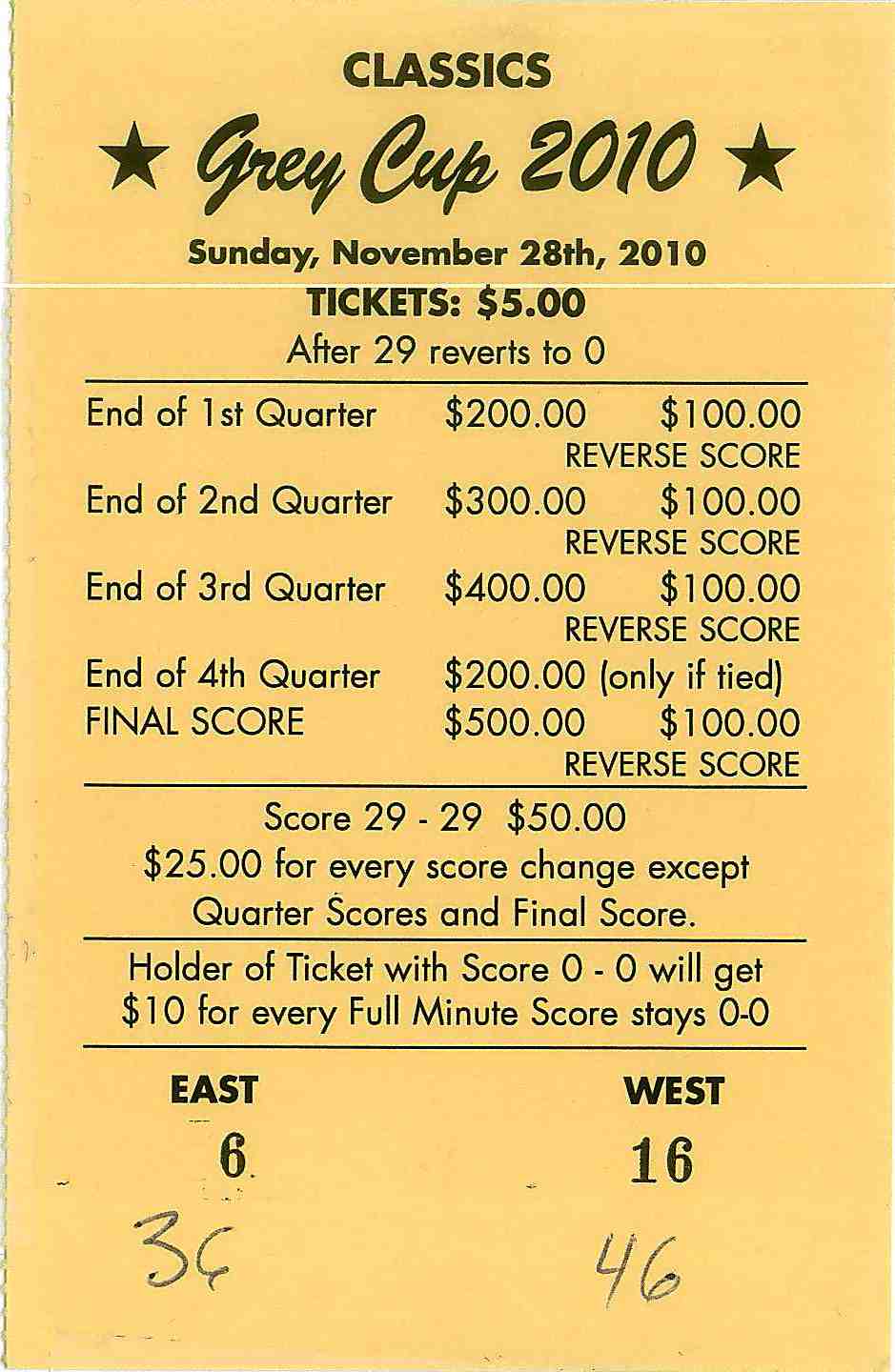
But, this fushigi started with GD selling a Grey Cup game pool ticket, as he does every year, to me yesterday. I gave him my money in exchange for a sealed envelope. When I opened it, the very official looking ticket had the initially dismaying numbers East 6 || West 16.


'Oh,' I said, 'these are not very good numbers [for football scores.]'

'Nah,' he countered, 'the 6 isn't great, but the 16 isn't bad.'

'You think so?'

'Of course. There was a 16 at some point in last year's Grey Cup,' he said.

I went away with my ticket, not fully convinced of his argument. But after watching the Edmonton Saskatchewan game — see below — I looked it up and he was right. And, furthermore, it turns out there was also a 6! And the only reason I looked that up in the first place was because, in yet another example of the humorous perversity of life, today's game contained a quarter in which 6 points were scored and the half finished with Edmonton having 16 points.

I know, I know, just a coincidence! But I repeat: at what point does a long series of improbable coincidences stop being just coincidences?


Sunday, November 7, 2010

2010.11.01 — Where's the Cheese? In Agassiz — a Fushigi


The blog that can't help but be made irrelevant extends that into inane cheesiness.

This morning at work, BV asked me to check out the main-frame application she was using. 'Have you seen this before?' she asked. BV asked not just because we sit in the same pod, but because I am far far more experienced with this application than is BV. As it turned out, I hadn't seen this particular problem before. After poking and prodding the application, it became clear that shutting it down and restarting was at the very least needed and which would hopefully re-align the electrons in their clouds to improve the weird output we were seeing. And in fact, that turned out to fix the problem, which was to check for what are called 'binder' comments on the record for a cable in the Agassiz exchange area of BC.

In typical fushigi fashion, nothing special in this — except, perhaps, for my not having seen this trouble before despite having more than fifteen years of experience with the application. Otherwise I would not have seen on BV's computer that the trouble happened to have occurred in one of BC's small exchanges.

As you can see it is a farming community.

And so it came to pass that later that night, while flipping through the TV stations, I stopped when I heard the host of 'Pitchin' In,' chef Lynn Crawford, comment about being in Agassiz, in the beautiful Fraser Valley, looking to learn about everything that goes into artisan goat cheese. But you might want to say that this is not a fushigi because I watch 'Ptichin' In' regularly. Well, that's just not the thing, because I've at best watched it occasionally, perhaps even rarely — in its one and half seasons, Agassiz's cheese was the 4th episode I've seen — the other three being Lobster, Oranges, and Pigs. Also, this was the first time I've watched it on a Monday, my previously exposures to it having been on weekends. And the only reason I stumbled into it this time was because my 'normal' Monday night viewing was disrupted by the World Series and repeats.


Thursday, October 28, 2010

2010.10.28 — Is it me being a jerk, or is life jerking my fushigi chains?

Have you ever wondered where the name 'jerk', as in jerk chicken or jerk pork, came from? Earlier this week, on Tuesday I believe, the Canadian Food Network cook, Michael Smith did. He asked it out loud while I was cooking in the kitchen and my wife was watching him make jerk pork (I think). He said, paraphrased from memory, 'I bet it comes from the head jerking back when you get hit by all those flavours!' (Or words to that affect.)

So, I ask, is life jerking me around, am I slowly going nuts, or did I experience another fushigi last night when I read the following:
Johnnycake is sometimes said to be a contraction of journey cake, the idea being that it was a food packed for journeys. But since it is a kind of cornbread, and cornbread patently is not a travelling food, the explanation is unconvincing. Another suggestion is that it is a corruption of Shawnee cake. In New England it was called jonakin or jonikin long before it was called johnnycake, suggesting that johnnycake is a folk etymology based on some earlier, forgotten, Indian term. Two native American foods that were designed for travelling were pemmican and jerked beef. Despite the name, nothing is jerked to make jerked beef. The word comes from charqui, a Spanish adaptation of a Peruvian Indian word. Though the variant name jerky is etymologically closer to the Spanish original, it actually entered the language much later. Jerked beef was well established in the colonies by the early eighteenth century. Jerky isn't attested before 1850. Pemmican, more straightforwardly, is from the Cree pimikân (p184).
Bill Bryson.
Made in America:
An Informal History of the English Language in the United States
.
New York: Perennial (HarperCollins), 2001.


Synchronicity-petite or just a 'coincidence?'
Is this an interesting suggestion as to how pervasive is the interconnectedness of the world, as is argued by physicists who support string and super-string theories? Or is my finding these things interesting just my becoming fixated like a madman on a whiff of nothing, a puff of meaninglessness in a meaningless world? Hmmmm. And I guess my blog has truly degenerated into a place of fushigi.

Monday, October 25, 2010

2010.10.24 — By George, I Think I Hear Another Fushigi

Well, well well. It would seem that with all the so-called busy-ness I can claim to have around me, this blog is bogging down, or is that listing towards, a fushigi listing. I was briefly tempted to spend time gnashing my teeth at my wasting of life's time by doing this instead of creating important world-saving obstreperous pontifications about social injustice or other worldly (or is that other-worldly) issues of grave meaning and mortal import. Alas, but temptation fell to my real temptation, which is to post another meaningless, but very amusing, fushigi — or, as I am wont to call them, synchronicity-petites.

It begins with a book I am reading with great enjoyment — but which I haven't charted on my
book blog yet. And that is


Bill Bryson.
Made in America: An Informal History of the English Language in the United States.
New York: Perennial (HarperCollins), 2001.


Like all true synchronicity-petites, it begins with something small. In this case, it was a fascinating item, a tiny nugget of history of which I was completely unaware, like the hundreds of others both big and small that preceded it, . until Made in America illuminated it with ease, grace and such power that it even without being 'fushigified' it would have lived on in my memory and imagination for a long time.
Pullman cars, originally Pullman Hotel-Cars, were named for George M. Pullman, who developed them in 1865, and dining cars in 1868. To accommodate his twelve thousand workers, Pullman built a model community, Pullman, Illinois (now part of greater Chicago), where workers lived in company houses and shopped at company stores, thus ensuring that most of what they made returned to the company. That Pullman porters were nearly always black was not a result of enlightened employment practices, but a by-product of abysmal pay. The custom of calling porters 'George,' whatever their name, was apparently from Pullman's own first name (161). 
When I finished reading that, I put the book down, bemused and humbled by how much history I do not know. And at how labour has always been exploited, if not by 'honest' slavery, then by slavery masked behind structured indenture-hood of one form or another.


Then, being fully a member of the privileged middle-class, I went about the rest of my afternoon doing those easy lazy things that comprise my life on a work-free Sunday afternoon. Eventually, late in the afternoon, I turned on the TV to watch the time-shifted-from-the-east finale of 'So You Think You Can Dance Canada'. (Sigh. That sounds so trite — is so trite. But there you go, I did say I am a full member of the comfortable middle-class.) And, in typical fashion for me watching commercial bloated TV, I flip through stations during the ads, and stopped at a strange movie title with at first, disbelief, and then amazement. The title was one I'd not seen before. I know I'd not seen it before because if I had I would have remembered it, not just because I am very good with movie titles and actors, but because the title is absolutely rememberable and truly unique: 


When I looked up '10,000 Black Men Named George'  at iMDb, it would seem that the movie was not well promoted by its producer, Paramount Network Television Productions, because of all the movies I've researched on iMDb '10,000BMNG' has the absolute fewest number of ratings and reviews I've ever seen, 168 and 8 respectively. There are few photos, almost no biographical information, and a single sentence plot synopsis:

Union activist Asa Philip Randolph's efforts to organize the black porters of the Pullman Rail Company in 1920s America.

This for a movie about a man who had a huge impact on the labour and the civil rights movements in the USA. iMDb includes an interesting historical footnote in the 'Fun Facts' section:
Title Card: On August 25th, 1937 the Pullman Company signed the first ever agreement between a union of black workers and a major American corporation. It was twelve years - to the day - of the founding of the Brotherhood of Sleeping Car Porters.
Title Card: For the next four decades Randolph carried forward his fight for equality. In 1963, commemorating the 100th Anniversary of the Emancipation Proclamation, Randolph initiated the March on Washington for Jobs and Freedom. It was at that gathering that a young Martin Luther King, Jr. delivered his "I Have a Dream" speech... and Randolph passed his torch to a new generation of leaders in the fight for Civil Rights. 
Unfortunately, my TV flip occurred with only 10 minutes or so left of the movie, so I did not see it.

But, there you have it. A very interesting fushigi, or, if you prefer, synchronicity-petite.